Showing posts with label Websites. Show all posts

Sunday, February 8, 2015

Dahlias 2015


Snowflake


Lucky


Excentric


Star's Favorite


Kogane Fubuki


Hawaii


Noordwijk's Glorie


Arabian Nights


Seattle


Firepot


Firepot

It may be snowing record amounts here in Massachusetts, but I'm very excited for a new growing season!!  I confess I spent many evenings in December pouring over my Swan Island Dahlia catalog before going to sleep.  It was so hard to decide which to purchase, especially after discovering two new dahlia farms! :) It got so I would see dahlia forms in my mind as I drifted off to sleep.

The pictures above are dahlias that I already own.  They are over-wintering in my basement, as Massachusetts is within Hardiness Zone 5 (Zone  6 is pushing it, I think).  Dahlias grow in zones 8 to 10.  For anyone interested in how to save dahlias for additional seasons, see this post.

For anyone interested in purchasing dahlias, I bought most of the ones you see above at either Lowe's or Home Depot.  I found a couple of them at Stop and Shop.  Only two remain from Swan Island Dahlia.

Here are some wonderful sites:

Thursday, April 10, 2014

Apple Trees and Other Fruit Trees - Pruning and Disease

I pruned my apple trees on April 5.  I knew I had to hurry, as the daily temperature is warming up and the trees will soon be in bloom.  The best time to prune apple trees and other fruit trees is while they're still dormant, which is late winter to early spring.  However, I did read somewhere that any pruning is better than no pruning at all. Again, I followed the instructions I received at a WMMGA seminar.

I pruned my plum tree, nectarine tree and pear trees yesterday, on April 9.  My plum tree looked horrendous.  It had (and still has) "wounds" all over and looks pathetic.  I'm wondering if I should rip it out?  I tried to prune off as much of the wounded wood as I could, but the trunk also has gaping wounds. The base of the trunk is also a mess with chewed bark. I feel so bad for this tree!  I wonder if I should call a tree specialist or just consult a good book. Maybe I should send pictures into the email hotline!? Now there's a thought!


 All of the trees showed a lot of new growth, but a lot of that growth had to be cut off in order to let light and air through the tree.  Also, many of the branches were growing either straight up or straight down, or they were growing inward or rubbing against each other.  I cut so much that I was worried I wouldn't have anything left of the trees!  However, this is good for the trees and will result in a lot of fruit (I hope!!)


Pruning got a little tricky where "central leaders" were concerned.  All of the trees have obvious central leaders except for my nectarine tree.  There just isn't one central leader. As a result, it looks like a tuning fork!  I think this is because it wasn't pruned properly in the past.

Saturday, March 8, 2014

Seed Starting Dates

Early March
Seed                Date      Germinated   Transplanted
Cabbage             March 5   March 7      March 18, 24
Head lettuce        March 5   March 7      March 18, 24
Peppers             March 5   yes
Ageratum            March 5   March 7      March 18, 24
Rudbeckia           March 5   March 7      March 24
Verbena             March 5   March 8
Chives              March 5   yes          March 18
Thyme               March 5   March 7

Mid-March
Seed                Date      Germinated
Purple Coneflower   March 14  March 18
Lavender            March 14  March 26
Spinach             March 14  March 18
Arugula             March 14  March 16
Kale                March 14  March 16     March 24
Striped Marigold    March 14  March 17
Milkweed            March 19  March 24
Cosmos              March 19  March 21
Cleome              March 19
Eggplant            March 19  March 24
Basil               March 19  March 21

End of March
Seed                Date      Germinated
5-Star Grape Tomato March 31
Bellstar Tomato     March 31
Brandywine Tomato   March 31


Some Helpful Online Seed Starting Charts
Johnny's Select Seeds
A Way to Garden.com
The Old Farmer's Almanac

Wednesday, March 5, 2014

Connecticut Flower and Garden Show


 I went to the Connecticut Flower and Garden Show in Hartford last weekend with Grace and Nanhui.  I had never been and wasn't sure what to expect, but usually, if it has anything to do with flowers, I'll probably enjoy myself.

The three of us wandered down aisle after aisle of colorful, creative "landscapes". There were also plenty of businesses displaying things for the yard and garden.  I was impressed with a lot of the garden furniture I found there. First, there was H & H Outdoor Accents, which sells some great benches. I was also enchanted by some chairs sold by the Vermont Cedar Chair Company. So fun and comfortable!  

I absolutely loved looking at the beautiful herbs and citrus trees that Ballek's Garden Center had on display.  I spoke with a woman who works there about lemon trees, since there was a beautiful lemon tree for sale.  I told her about my two seven-year old trees that I grew from seed and asked her how much longer I would have to wait before I would get some lemons.  She said SEVEN MORE! I wasn't expecting that answer.  I think I'll just buy one that will give me lemons this year. I'd also love to pick up one of their orange trees.  So beautiful. I also discovered that I can buy Virginia Bluebells there.  I may just have to go and check them out.

I found plenty of inspiration there.  I loved all the fun pots and decorations for the garden. Garden Girl - that's me! Also, the stone and log garden paths are very charming.

A final great discovery:  Connecticut's Historic Gardens.  The state boasts 14 distinctive sites.  I will definitely be checking some of these out this spring and summer.


Friday, September 6, 2013

My Lemon Trees Have Yellow Leaves

I have two lemon trees, and I am the first to admit that they don't look that great. But, I also grew these from seeds and admit that I didn't know a thing about fruit trees until I joined the Western Massachusetts Master Gardeners Association.

The trees are 6 years old and have never grown 1 lemon.  I've yet to see any flowers, and half the time I'm lucky if the trees have branches ( I used to get a little carried away with pruning).

So this year, for the first time, I brought the trees outside and I fertilized them at least every 6 weeks with a citrus fertilizer.  I did see a lot of growth and I've had to prune the trees back a little.  I really need to get bigger pots for them, but I'm afraid I won't be able to carry them in the house if I do.

Anyway, lately, the leaves look very yellow and are beginning to drop off - even with all my extra care! 


I went online to see if I could find a cause and a solution for yellowing leaves, and discovered a forum on gardenweb.com. After reading many comments, I decided to get my hands on some Dyna-Gro Foliage Pro.  Many growers of lemon trees swear by this stuff.  I bought a small bottle that I found on amazon.com and have saved the customers' reviews page.
 
Today, I mixed a teaspoon of DGFP with a gallon of water and fed the trees.  Then I used the solution half-strength (1/2 tsp. per gallon) to spray on the leaves. I simply filled a spray bottle half-full with the solution, and then filled the rest with plain water.  I hope this helps to really green the leaves up. I will post results as I see them.
 

Monday, May 6, 2013

Hardening Off

After it was suggested that my plants have "fungus mites", I was told to start bringing my seedlings out into the light and air.  So, I decided to start hardening them off.
 
 
I know the goal of hardening off is to get the young plants gradually used to hotter and colder temperatures.  The other night, I left the plants out until it reached 50F.  The tomato plants looked like they were cringing:

They did recover, and I've been putting them outside and keeping them there until the temperature hit 48F.  When I brought the seedlings in, the eggplant seedlings, cantaloupe seedlings and cucumber seedlings didn't look so hot.  They looked very pale, and like they were losing their green color.

I went on line to see if I could find out more about hardening off.  I learned that certain plants should not be kept outside in temperatures below 60F, because they are tender.  I also read that the hardening off process should begin a week or 2 before planting day.

I have decided to bring the plants in when it gets down to 60F, and take a couple of weeks to fertilize the plants a bit.  I am starting with Super Thrive.

Recommendations Taken From Washington State University
  1. Harden off gradually, so that seedlings become accustomed to strong sunlight, cool nights and less-frequent watering over a 7-10 day period.
  2. On a mild day, start with 2-3 hours of sun in a sheltered location.
  3. Protect seedlings from strong sun, wind, hard rain and cool temperatures.
  4. Use an automatically opening cold frame, if you have one.
  5. Increase exposure to sunlight a few additional hours at a time and gradually reduce frequency of watering, but do not allow seedlings to wilt. Avoid fertilizing.
  6. Keep an eye on the weather and listen to the low temperature prediction. If temperatures below the crop's minimum are forecast, bring the plants indoors or close the cold frame and cover it with a blanket or other insulation.
  7. Know the relative hardiness of various crops. Onions and brassicas are hardy and can take temperatures in the 40's. After they are well hardened off, light frosts won't hurt them. Warm-season crops such as eggplants, melons and cukes prefer warm nights, at least 60° F. They can't stand below-freezing temperatures, even after hardening off. (See chart below for more detail.)
  8. Gradually increase exposure to cold.
  9. Root-prune plants in flats a week before setting out. Use a sharp knife and cut down to the bottom of the flat between the plants. Water thoroughly.
  10. After transplanting to the garden, use a weak fertilizer solution to get transplants growing again and to help avoid transplant shock.

Recommended Minimum Temperatures
Hardy40° F.Broccoli, Brussels sprouts, kohlrabi, cabbage, onions, leeks, parsley
Half-Hardy45° F.Celery, Chinese cabbage, lettuce, endive
Tender50° F.Squash, pumpkin, sweet corn
60° F.Cucumber, muskmelon
65° F.Basil, tomatoes, peppers
 
This chart has been taken from Washington State University


Wednesday, April 24, 2013

Bringing Out the Dahlia Tubers for Planting

My new dahlia tubers arrived from Swan Island!  I'm so excited!  I decided to plant my old dahlia tubers that I stored over the winter in containers to give them a head start.  This is purely experimental, so I don't want to try it on my new ones.

In October (maybe November), I dug out the tubers 2 weeks after the killing frost, and I washed them off, dried them and then packed them with peat moss in a box and stored them in my basement.  I checked on them once, and they looked OK.

Well, I pulled them out yesterday and I was so dismayed.  This is what I found:


The first two tubers to come out of the box were shriveled and desiccated.  However, as I continued to reach in the box, the rest of them looked OK:


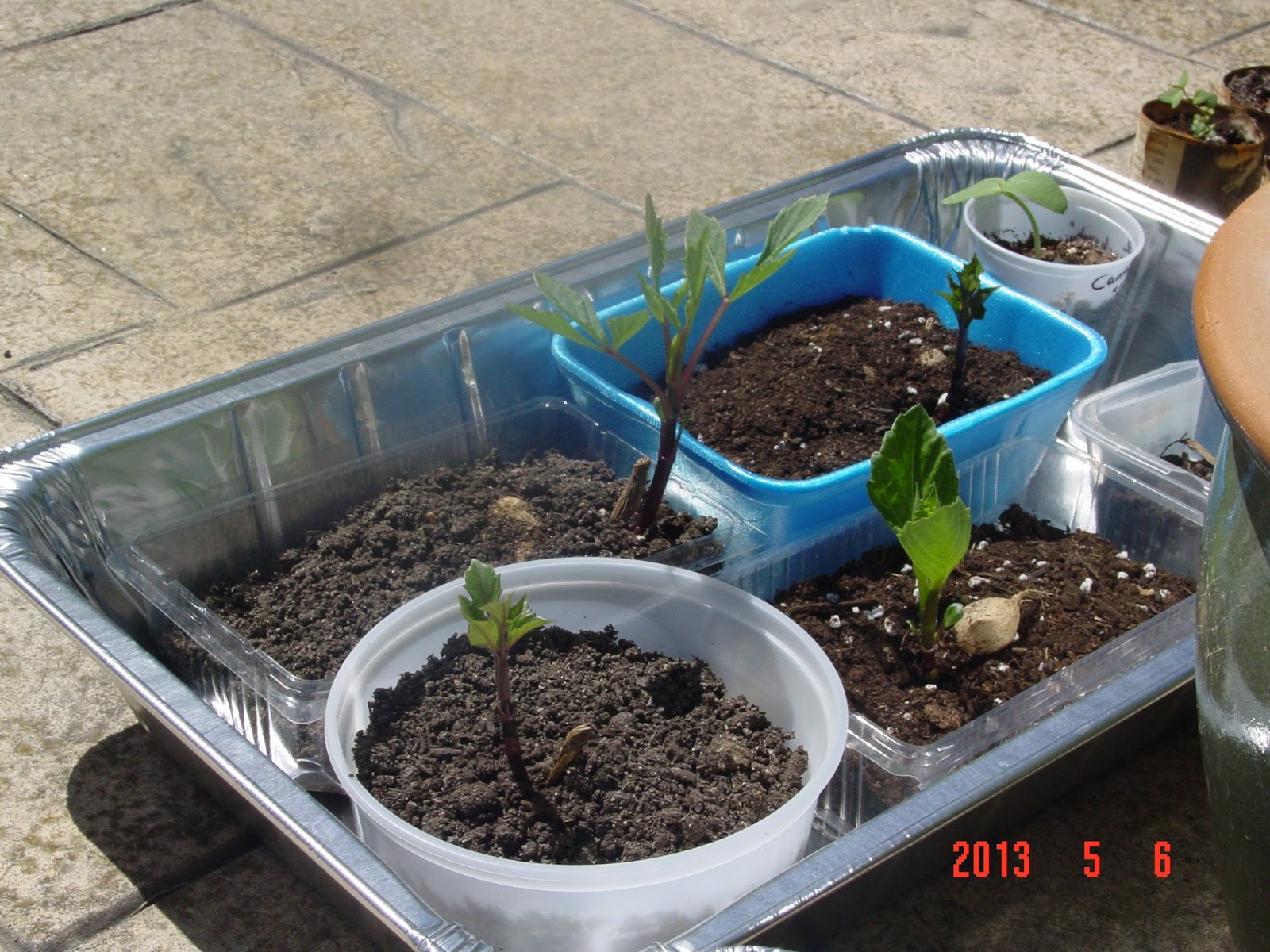
They had even begun to send out shoots!  So I used a bunch of old containers to lay them in and covered them with some moist potting soil - being sure to let the shoots show, and stuck them under the grow lights.   I have 5 of them.  I have no idea which is which, because I didn't keep track to them very well.  I have since leaned that you can actually write the name of the dahlia right on the tuber with a Sharpie.


After just 2 days, the sprouts started to turn red:


Here they are, a week and a half later, outside and growing steadily:


All of my new dahlia tubers are still in the box from Swan Island.  I will put them out when the days and nights are warmer.  Then, in September, I will determine whether or not it's worth potting them ahead.


Too Late for Pruning Fruit Trees, and Other Mistakes

Unfortunately, I have been so busy for the past couple of months that I never set aside enough time to prune my fruit trees.  This is unfortunate, because this is their second year in my yard, and I have never pruned them.  Fruit trees need to be trained while they are still young to encourage good framework.  They will be healthier, stronger and more fruitful in the long-run.  Fruit trees are supposed to be pruned while they are still dormant, but I saw today that all of my trees are in bloom.  The ideal time to prune fruit trees in Massachusetts is late March.  I have no choice but to wait until next year. This is already on my March To-Do List, but next year I will be sure to make it a priority.

I did take time to examine all of my trees today.  So many issues.  For starters, I have the wrong pruners.  These have a blunt edge.  I need to get pruners that have 2 sharp edges.  Also, I'm supposed to keep these things clean!


I noticed that most of the trees have multiple central leaders instead of one, and that most of the trees have very narrow crotch angles, which means that the trees are susceptible to breakage in storms.  This tree needs to be thinned out, but it already has buds.  Also, I need to start putting weights on some of the branches to encourage them to drop, creating wide crotch angles:


This tree has multiple leaders and needs to be corrected next year:


I also discovered other signs of abuse and neglect.  For instance, I just got around to removing the tags from all my trees.  Shame.  Also, I need to put mulch around the trees to protect them from weed-wackers and lawn mowers:


Lastly, I need to get some tree wrap to protect the trees from deer, mice, and sun.  My plum tree has suffered from either deer rubbing against it or sun-burn - not sure which.  I intend to wrap them as soon as possible and put wire mesh around all the tree trunks.  Also, some of the trees trunks are being chewed by mice or voles:


The pests can be brutal.  I didn't realize baby trees were so vulnerable.
 
Before I went out to prune the trees, I reread my post from early April about pruning fruit trees.  However, I didn't feel like I had enough information, so I did a little more research.  Here are some other useful sites:


Tuesday, April 2, 2013

Pruning Apple Trees at Cold Spring Orchard

Today, I joined other "master gardeners" at Cold Spring Orchard in Belchertown to learn how to prune apple trees.


It was freezing!!  But, as this is the time of year to prune fruit trees, it was good experience.

This is Dr. Wes Autio, a specialist in fruit trees.  He is a professor at UMass and was our instructor today:


One of the first things we learned is that a true horticulturist only uses the best quality tools.  That goes for aspiring horticulturists like myself.  Hmm.  Guess my OSJL tools don't count.  I didn't dare take them out of the car!

Wes suggests buying our tools from Oesco (Orchard Equipment Supply Company) because they have the best tools available, and because they are a local company (Conway, MA).  I picked up one of their catalogues when I went to the blueberry pruning seminar last month.  The tools needed for proper pruning are hand-pruners, loppers and pruning saws. Some of the brands Wes highly recommends are Felco, Barnel, Pica (hand-pruners) and Silky (saws). 


In this picture, he is demonstrating how to sharpen tools.  In his right hand is a sharpener (diamond stone, "medium").  You are only supposed to sharpen the beveled side.  Run the sharpener along the bevel, against the cut itself, then turn the blade over to clean the bur (deburring) by rubbing the sharpener flat against it.

Also, it is recommended that you oil the tools with a light oil and keep them clean, either with water or WD-40 (I actually discovered that we have a can of this in the basement!).  Wes says he doesn't worry too much about disinfecting the tools, and says that it is not necessary unless you've been working with plants that are diseased.

Now, for the apple trees!


I can just picture this place when the trees are in bloom!!

We were all given a bookmark/factsheet about apple tree pruning and training:
  • Sunlight turns buds into fruit buds.
  • Training and pruning should maximize sunlight in the tree.
  • Shade is your enemy - All parts of the tree should receive sunlight.
  • Pruning Stimulates new shoots which will produce fruit buds the following year and bear fruit the next year.
There are seven rules, to be completed in order:
  1. Remove 2 or 3 of the largest limbs in the top two-thirds of the tree.
  2. Use the 2-1 rule (diameter-based pruning).  Remove any scaffold branch or limb that is half the diameter or larger than the central leader.  A branch of this size chokes out the leader, not allowing the tree to reach optimal fruiting capacity.  Use bevel cuts to remove these limbs.
  3. Avoid heading cuts - remove the entire limb instead.
  4. Avoid complex branches in the lower one-third of the tree.  As branches on lateral limbs get older they develop additional branches.  This is what we call a complex branch.  Leave the smaller pencil thick fruiting shoots.
  5. Remove downward hanging branches.
  6. Remove shoots that are growing straight up.
  7. Leave one shoot as a central leader - do not prune it.