Showing posts with label Tools. Show all posts

Wednesday, April 24, 2013

Grow Lights


My mother and I were on the phone the other day, talking about our gardens, and she told me that she used to grow plants in the basement, using a light and a card table.  She said that her system was kind of "crude", but it made me think that we all have to start somewhere.  This is the first light I used:


So high tech!  Then last year I sprang for a Hydrofarm Grow Light:


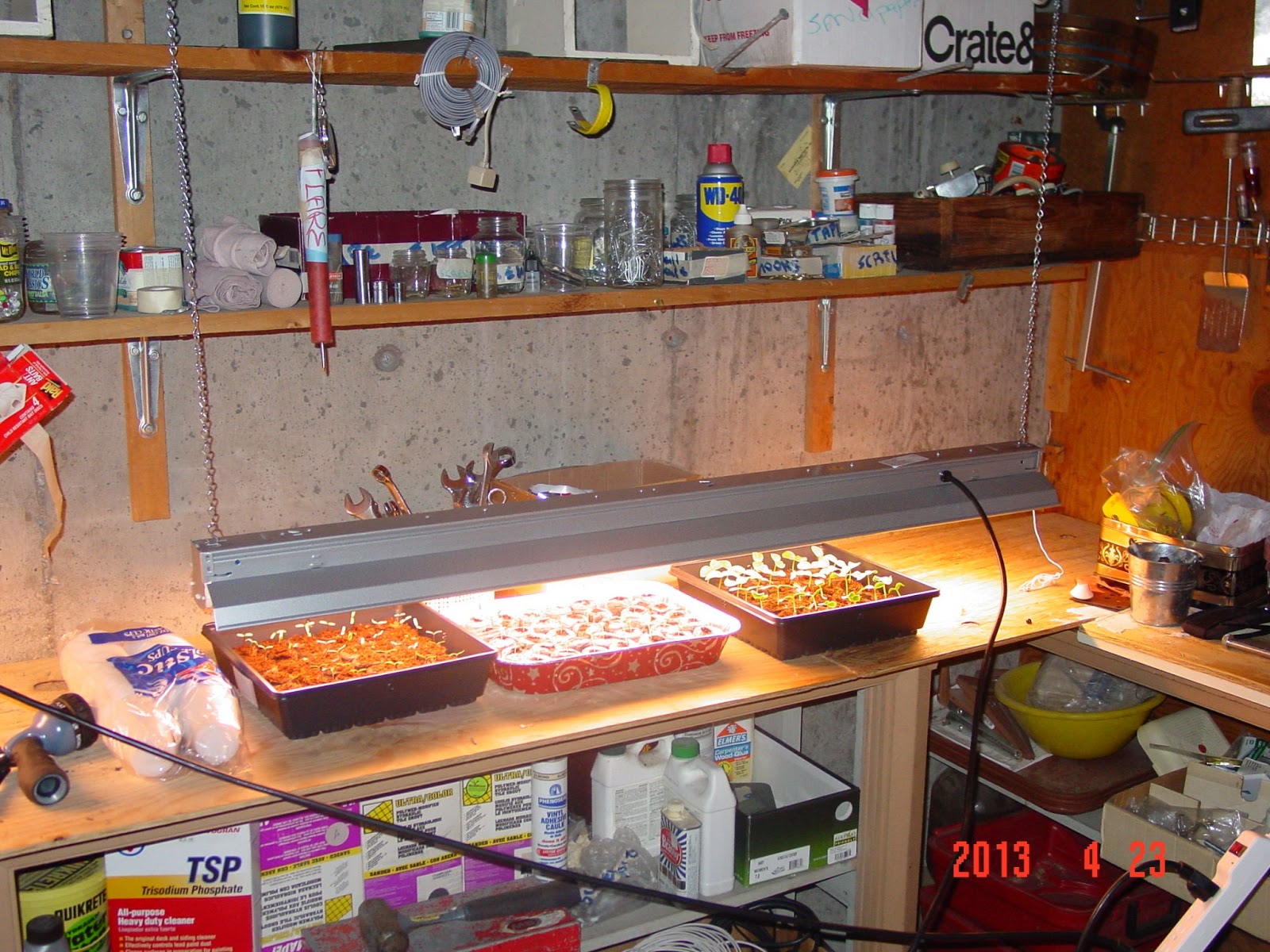
It's OK... not the greatest.  But then in my WMMGA group I learned that I can grow plants using ordinary florescent bulbs.  I set one up about a week or so ago, but now I have so many things growing, that I need to add another one:
 
 
These lights were very easy to set up, and cost about half the price.  This is what I purchased:
  • A 4-foot All-Season shop light
  • (2) 48-inch T8 32 watt florescent bulbs
  • (2) 4-foot chains to hang the light from the ceiling, so I can raise and lower it as needed
  • (2) 1-1/2 inch cup hooks, on which to attach the chains to the ceiling


Too Late for Pruning Fruit Trees, and Other Mistakes

Unfortunately, I have been so busy for the past couple of months that I never set aside enough time to prune my fruit trees.  This is unfortunate, because this is their second year in my yard, and I have never pruned them.  Fruit trees need to be trained while they are still young to encourage good framework.  They will be healthier, stronger and more fruitful in the long-run.  Fruit trees are supposed to be pruned while they are still dormant, but I saw today that all of my trees are in bloom.  The ideal time to prune fruit trees in Massachusetts is late March.  I have no choice but to wait until next year. This is already on my March To-Do List, but next year I will be sure to make it a priority.

I did take time to examine all of my trees today.  So many issues.  For starters, I have the wrong pruners.  These have a blunt edge.  I need to get pruners that have 2 sharp edges.  Also, I'm supposed to keep these things clean!


I noticed that most of the trees have multiple central leaders instead of one, and that most of the trees have very narrow crotch angles, which means that the trees are susceptible to breakage in storms.  This tree needs to be thinned out, but it already has buds.  Also, I need to start putting weights on some of the branches to encourage them to drop, creating wide crotch angles:


This tree has multiple leaders and needs to be corrected next year:


I also discovered other signs of abuse and neglect.  For instance, I just got around to removing the tags from all my trees.  Shame.  Also, I need to put mulch around the trees to protect them from weed-wackers and lawn mowers:


Lastly, I need to get some tree wrap to protect the trees from deer, mice, and sun.  My plum tree has suffered from either deer rubbing against it or sun-burn - not sure which.  I intend to wrap them as soon as possible and put wire mesh around all the tree trunks.  Also, some of the trees trunks are being chewed by mice or voles:


The pests can be brutal.  I didn't realize baby trees were so vulnerable.
 
Before I went out to prune the trees, I reread my post from early April about pruning fruit trees.  However, I didn't feel like I had enough information, so I did a little more research.  Here are some other useful sites:


Tuesday, April 2, 2013

April Last Year


I found this in on my computer in my documents - not a very effective way of keeping records.  I prefer this blog because it allows me to keep everything so organized and I can find anything I need with a click of the mouse.

Rereading this entry from last April reminded me that it was actually hot at this time last year!  Today (April 2) was freezing!

Here are my notes from last year:


April 16, 2012

Today is unusually warm for Massachusetts – 91 degrees!  We had mulch delivered on Saturday, the 14th, so Jamie has been laying it all around the garden beds up front – to start.

I have been yanking weeds.  Buckets full.  I feel like I’m wasting a lot of time, but I also feel like it’s better to yank them than to pour more chemicals in our yard.  Also, if I yank them, hopefully they won’t spread their seeds.  I read that the grass has a better chance of growing thicker when it doesn’t have to compete with the weeds. Makes sense.

We hired WEED MAN to do our lawn for us this year, but we asked them not to touch the yard on the side of the pool by Jan’s house, because that’s where a vegetable garden is going.  We don’t want any chemicals touching any veggies we’ll be eating.

We have asked Joe to mow our lawn for us.  Two calls to him so far.

I am ordering another grow light.  I resurrected one that I bought about 20 years ago and have put a bunch of seeds under it:  snapdragon (3/?), poppies (?), plum tomatoes, peppers, cosmos (4/2).  So far, everything is taking off except the peppers.  I’m a little concerned because the tiny plants seem to reach a certain height and then flop over.  I see this happen with all of them except the poppies – probably because they are still quite small.  Overcrowding is another problem.  When I go to thin the plants, I end up killing some of them because they are disturbed.  Next year I will sow the seeds more sparingly.

I started a compost pile behind my shed.  I admit, I don’t really know what I’m doing.  But you have to start somewhere!  I threw in all the grass that grew into my flower beds, all the weeds that I yanked, plus stuff from my kitchen, like old broccoli, green onion tops, orange rinds, banana peels and a little spaghetti.  Don’t know if any of this is off-limits for a compost pile, but I guess I will learn.

I planted some sweet pea seeds in a shallow terra cotta container.  I plan to make a trellis for it out of branches when the little plants emerge.

I need to get all of my tools organized so that they are easy to get to and don’t get lost in the shuffle.

I had to stop myself from ordering a half dozen books online last night.  I have so many questions, so many goals.  I need to remind myself constantly that there is no rush… I have lots of time to learn and it’s OK to make mistakes.  I need to enjoy the process, just as I have enjoyed learning the process of cooking over the years.

April 23, 2012

I’m reading a book called Square Foot Gardening, by Mel Bartholomew and I am really excited because it makes gardening seem so much easier, not so overwhelming.  Already I got a great tip for starting seeds – don’t use nearly as many seeds when starting plants, and cut the extra seedlings with scissors instead of ripping out.  So smart!


I set up my new grow light and moved it into Jamie’s room.  He insists.  Poor guy – it seems so bright!  I sowed more seeds tonight – dill, parsley, zinnias and basil.  I discovered that my peppers, which are finally starting to shoot up after 21 days, are organic, so I will be able to save seeds.  The plum tomatoes are also organic.  I made little signs to put in the trays and removed the seed packets, which were getting wet.  Supposedly, the seeds will last for a few years if stored properly.  I have them in a little plastic filing case but need to find something bigger.

May 3, 2012

I planted more seeds on the 27th, April:  3 different kinds of zinnias, cucumbers and zucchini squash.  I’m beginning to realize that I should have started the seeds earlier.  The plants are all tiny – especially the snap dragons.  I guess I’m supposed to put a heating pad under the seeds.  Maybe I’ll try that next year… I don’t know.  It seems like growing seeds can get kind of expensive after a while.  Might as well just go out and buy the plants!  I’m keeping track of all of my expenses, so I’ll see whether it’s worth it or not.  Any way, it is a good thing to know how to grow things.

That 90 degree weather we had a couple of weeks ago convinced some of the shrubs to send out its blooms a little early.  A few nights ago, we must have experienced a frost, because I noticed our lilacs are almost dead, and I barely noticed they were out yet.  Some of the azaleas were also affected.  I made me sad to see all the little frost-burned lilacs and white flowers.

I mowed the lawn for the first time the other day – good thing, too, because we’ve had nothing but rain since.  I did the front; Jamie did the rest.  I want to take care of our own lawn, because I think it’ll look better if we take more of the responsibility on ourselves.  I need to start reading more and make some plans to care for this lawn.

I spent a lot of time cleaning up the flower bed by the garage.  Grass had grown through where juniper and phlox are supposed to be.  I’m going to lay some new weed cloth there.

Finally, I went to Lowes and priced boards to make my square foot gardens.  It’ll cost about $10 per garden for the wood.  I need to find someone to help me cut it, since Jamie doesn’t really have the tools, and neither of us have the know-how.


Pruning Apple Trees at Cold Spring Orchard

Today, I joined other "master gardeners" at Cold Spring Orchard in Belchertown to learn how to prune apple trees.


It was freezing!!  But, as this is the time of year to prune fruit trees, it was good experience.

This is Dr. Wes Autio, a specialist in fruit trees.  He is a professor at UMass and was our instructor today:


One of the first things we learned is that a true horticulturist only uses the best quality tools.  That goes for aspiring horticulturists like myself.  Hmm.  Guess my OSJL tools don't count.  I didn't dare take them out of the car!

Wes suggests buying our tools from Oesco (Orchard Equipment Supply Company) because they have the best tools available, and because they are a local company (Conway, MA).  I picked up one of their catalogues when I went to the blueberry pruning seminar last month.  The tools needed for proper pruning are hand-pruners, loppers and pruning saws. Some of the brands Wes highly recommends are Felco, Barnel, Pica (hand-pruners) and Silky (saws). 


In this picture, he is demonstrating how to sharpen tools.  In his right hand is a sharpener (diamond stone, "medium").  You are only supposed to sharpen the beveled side.  Run the sharpener along the bevel, against the cut itself, then turn the blade over to clean the bur (deburring) by rubbing the sharpener flat against it.

Also, it is recommended that you oil the tools with a light oil and keep them clean, either with water or WD-40 (I actually discovered that we have a can of this in the basement!).  Wes says he doesn't worry too much about disinfecting the tools, and says that it is not necessary unless you've been working with plants that are diseased.

Now, for the apple trees!


I can just picture this place when the trees are in bloom!!

We were all given a bookmark/factsheet about apple tree pruning and training:
  • Sunlight turns buds into fruit buds.
  • Training and pruning should maximize sunlight in the tree.
  • Shade is your enemy - All parts of the tree should receive sunlight.
  • Pruning Stimulates new shoots which will produce fruit buds the following year and bear fruit the next year.
There are seven rules, to be completed in order:
  1. Remove 2 or 3 of the largest limbs in the top two-thirds of the tree.
  2. Use the 2-1 rule (diameter-based pruning).  Remove any scaffold branch or limb that is half the diameter or larger than the central leader.  A branch of this size chokes out the leader, not allowing the tree to reach optimal fruiting capacity.  Use bevel cuts to remove these limbs.
  3. Avoid heading cuts - remove the entire limb instead.
  4. Avoid complex branches in the lower one-third of the tree.  As branches on lateral limbs get older they develop additional branches.  This is what we call a complex branch.  Leave the smaller pencil thick fruiting shoots.
  5. Remove downward hanging branches.
  6. Remove shoots that are growing straight up.
  7. Leave one shoot as a central leader - do not prune it.