Showing posts with label Tomatoes. Show all posts

Monday, July 22, 2013

Garden Notes - July 22, 2013


I spotted my first red tomato today! Well, it's almost red... I know to start my tomato plants (indoors) a little earlier next year.  At least 3 weeks earlier.  Still, there are dozens and dozens of green tomatoes on the vines.  I need to tie them up better since they are starting to sprawl all over the place.
 
 
The cucumbers are still going strong.  I've given a bunch away and I've been putting them in salads.  I made tabbouleh (sp?) and fattoush.  Delicious.  I even made pickles for the first time - "bread and butter" and "dill".  I think I'm done pickling cucumbers though.
 
I was beginning to think the rabbits were going to eat up all of my zucchini and yellow squash, but they are beginning to come in as well.  In fact, with the exception of the beans, basil, and cilantro, the rabbits have left quite a bit.  I can begin harvesting cabbage now, and the eggplants are almost ready for picking, as well as watermelons, and peppers.  I'm very satisfied! And James' garden is coming along - slow but sure!
 
The perennial garden needs quite a bit of work, as the weeds are coming in thick now.  I've been so busy weeding the vegetable beds and working on the front yard that the perennial garden has been neglected.  I spent an hour today cutting back dead bee balm and daisies, pruning the rose bushes, and pulling out hundreds of weeds.  I still have a lot left, which I hope to get to tomorrow. However, there are still loads of daisies and lilies, and the phlox and liatris are in bloom, and the "Black-eyed Susan" s are about to open.  The butterfly bushes have butterflies!
 
My annual flowers are doing OK.  I had planted some "snowball" marigolds in the perennial garden.  At first, the rabbits were chewing them up, but lately they are really taking off.  I also put in some bachelor button flowers, which I grew from seed.  They are finally in bloom and really pretty, but they are kind of lost among all the other plants.  Next year, I'll have to pick a different spot for them.
 
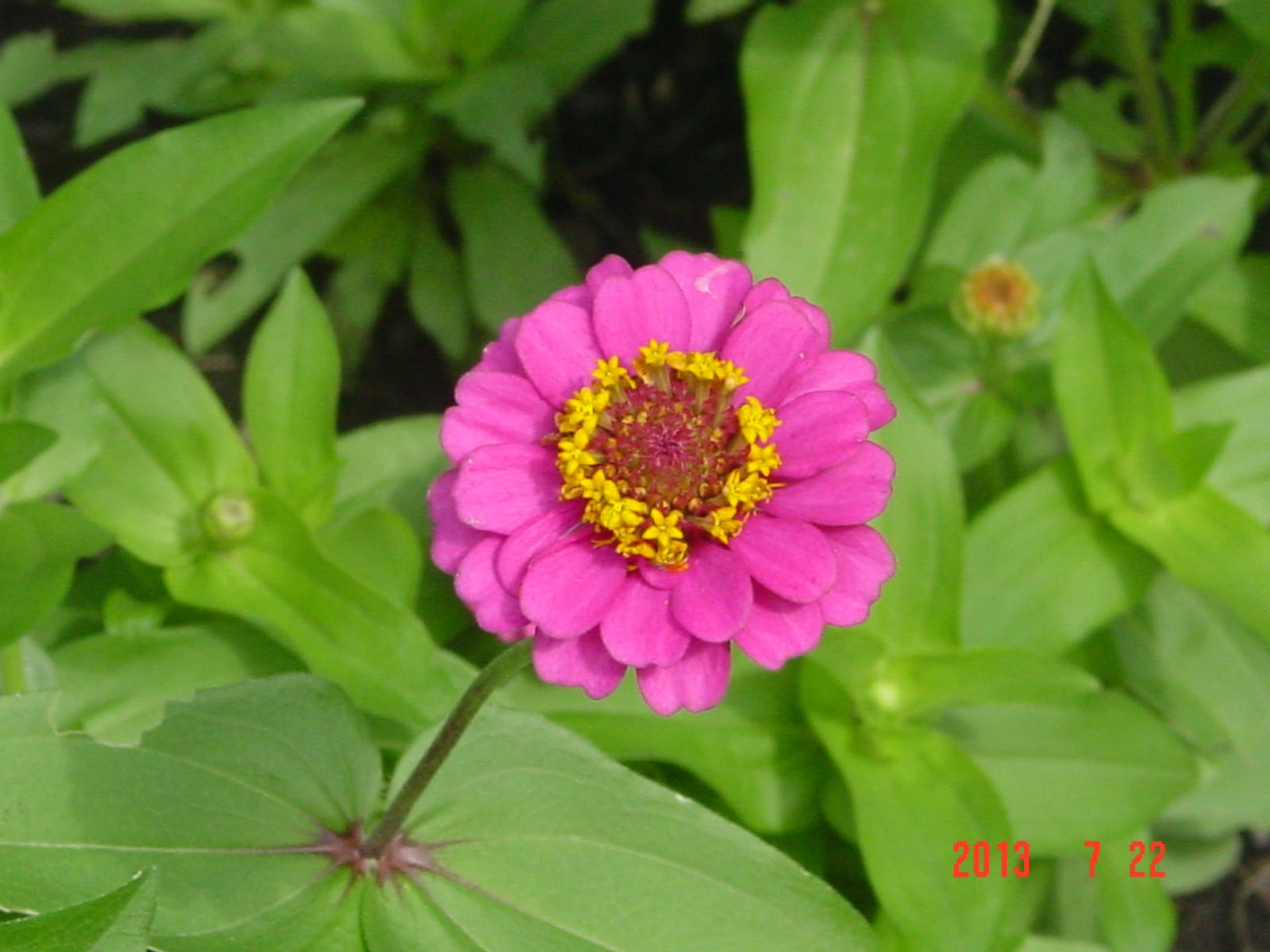
The zinnias are finally blooming.  I love all of them.  I had to spray all the annual flowers with a potent spray called "Bayer Advanced Natria" because all of the annual flowers were being attacked right out of existence.  I didn't want to use the stuff, but I decided it was the only way to preserve them.  I confess that I did not try any insecticidal soaps.  I tried it last year on the sunflowers and it did work, but I don't think it would kill the earwigs that are attacking the dahlias.  I sprayed the sunflowers, zinnias, bachelor buttons and dahlias. Only the cosmos ("volunteer") were left alone.  Next week I will follow up with the insecticidal soap, except for the dahlias.  I'll have to use the "Natria" on them.
 
Finally, I am able to pick some dahlia blossoms that haven't been eaten away by earwigs.  Incidentally, I have "lost" 2 of my dahlias - "Parakeet" and "Snowflake".  The dahlia bloom below comes from a tuber that I over-wintered.  I don't know it's commercial name... I think I'll name it "Embers". I just love the spectacular colors of dahlias.


Monday, June 10, 2013

Flea Beetles on the Eggplant and Tomatoes

I'm not sure what flea beetles look like, but The Organic Gardener's Handbook of Natural Insect and Disease Control (Ellis and Bradley) says they cause damage that looks like this:


The book says to use a spray or dust containing pyrethrin.  The book is for organic gardeners, so I'm guessing pyrethrin is safe enough (?)  I used a dust, which I found in the organic gardening section in Home Depot:
 

I did NOT like using this dust at all, and will go back to the spray I used on the cucumbers earlier in the week.  I dusted the eggplants and tomatoes on June 8th:


Sunday, June 9, 2013

Tomatoes and Shade

Unknowingly, I planted my tomato plants in the part of the vegetable garden that is the shadiest.
They get a little morning sun, which is then blocked by the oak tree (which may be coming down in the fall)  Yesterday, I kept track of how much direct sunlight they get, and was dismayed when I saw that they were in the shade again by 5:45 - which means they receive barely six hours.

In the afternoon,  this part of the vegetable garden is shaded by 2 pine trees.  Those pine trees are also coming down in the fall!
 
 
According to other gardeners writing on GardenWeb, tomatoes need 6-8 hours of direct sun and morning sun is best. 

Someone wrote a comment that bright shade also benefits the plants, and I'm pretty sure my tomato plants are getting plenty of that. After all, the rest of the vegetable garden gets about eleven hours of direct sun.

Thankfully, I planted a bunch of leftover tomato plants in containers yesterday.  They are sitting safely in the pool area, and get the same 10-plus hours that the other vegetables get.

I have started to notice that most of the tomato plants - although planted in the least sunny spot, have lots of flowers on them, and look like they will soon set fruit.  So maybe everything will work out!

Friday, May 24, 2013

Setting Up the Vegetable Garden

This has been an extremely busy time.  For more than a week, I have been gradually exposing the seedlings to higher and lower temperatures, as well as more and more hours of sun.  It's made for a lot of running around, since many afternoons have been both rainy and sunny.  I have been watching the weather reports to make sure that the plants never sat outside below 50 degrees.  They have been getting maximum sunlight, too, so I have had to make sure the plants didn't dry out.  All and all, they have gotten used to being outdoors.

The weather report said the cold nights were over - meaning not really going below 50 degrees, so I decided to start putting the plants n the ground.  I had fertilized the soil weeks ago, so all I have to do is dig the holes, add a little fertilizer for each plant (3 T).  It's an organic fertilizer for tomatoes and vegetables.


So far, I have planted 9 Bellstar Tomatoes, 7 Yellow Pear Tomatoes, 8 cabbage, 8 eggplant, 8 bell pepper, 8 watermelon and 7 cantaloupe plants.
 
 
For the tomato plants, I cut off the lowest branches, as they seem to suck up a lot of the plants energy/food, but won't bear fruit.  At least I don't think those branches will.  I read on a gardening website that it's good to do this, as well as plant a bit of the tomato plant's stem in the ground - I think this is so it will grow more roots and strengthen the plant.


So, now some of my concerns:
  1. Only after I put the plants in the ground did I discover that the next 2-3 days are going to be cold.  One of the nights will actually dip down to 38 degrees!! I think I may try to cover the seedlings at night to protect them.  I'm not sure how yet, but I'm going to have to act fast.
  2. I did not rake/level the garden as thoroughly as I should have, so it is pretty uneven in parts.  I'm not sure how this will effect the plants, but in the fall I'm going to rototill everything! I would have/should have done it this spring, but as always, I just can't seem to get to everything.
  3. I'm worried about pesky critters eating my plants.  I still haven't figured out how I'm going to enclose this huge garden....
  4. I did not even think to leave paths between the rows of vegetables, so it's going to be a little challenging moving about the garden.  I have only planted half of the garden, so I will be sure to leave myself more room when I plant the rest.
  5. I did not put any stakes in for the tomato plants and am considering doing it this weekend so I don't disturb the roots later.

Monday, May 6, 2013

Seedlings


Hardening Off

After it was suggested that my plants have "fungus mites", I was told to start bringing my seedlings out into the light and air.  So, I decided to start hardening them off.
 
 
I know the goal of hardening off is to get the young plants gradually used to hotter and colder temperatures.  The other night, I left the plants out until it reached 50F.  The tomato plants looked like they were cringing:

They did recover, and I've been putting them outside and keeping them there until the temperature hit 48F.  When I brought the seedlings in, the eggplant seedlings, cantaloupe seedlings and cucumber seedlings didn't look so hot.  They looked very pale, and like they were losing their green color.

I went on line to see if I could find out more about hardening off.  I learned that certain plants should not be kept outside in temperatures below 60F, because they are tender.  I also read that the hardening off process should begin a week or 2 before planting day.

I have decided to bring the plants in when it gets down to 60F, and take a couple of weeks to fertilize the plants a bit.  I am starting with Super Thrive.

Recommendations Taken From Washington State University
  1. Harden off gradually, so that seedlings become accustomed to strong sunlight, cool nights and less-frequent watering over a 7-10 day period.
  2. On a mild day, start with 2-3 hours of sun in a sheltered location.
  3. Protect seedlings from strong sun, wind, hard rain and cool temperatures.
  4. Use an automatically opening cold frame, if you have one.
  5. Increase exposure to sunlight a few additional hours at a time and gradually reduce frequency of watering, but do not allow seedlings to wilt. Avoid fertilizing.
  6. Keep an eye on the weather and listen to the low temperature prediction. If temperatures below the crop's minimum are forecast, bring the plants indoors or close the cold frame and cover it with a blanket or other insulation.
  7. Know the relative hardiness of various crops. Onions and brassicas are hardy and can take temperatures in the 40's. After they are well hardened off, light frosts won't hurt them. Warm-season crops such as eggplants, melons and cukes prefer warm nights, at least 60° F. They can't stand below-freezing temperatures, even after hardening off. (See chart below for more detail.)
  8. Gradually increase exposure to cold.
  9. Root-prune plants in flats a week before setting out. Use a sharp knife and cut down to the bottom of the flat between the plants. Water thoroughly.
  10. After transplanting to the garden, use a weak fertilizer solution to get transplants growing again and to help avoid transplant shock.

Recommended Minimum Temperatures
Hardy40° F.Broccoli, Brussels sprouts, kohlrabi, cabbage, onions, leeks, parsley
Half-Hardy45° F.Celery, Chinese cabbage, lettuce, endive
Tender50° F.Squash, pumpkin, sweet corn
60° F.Cucumber, muskmelon
65° F.Basil, tomatoes, peppers
 
This chart has been taken from Washington State University


Wednesday, April 24, 2013

New Method of Transplanting Seedlings

I had many new seedlings to transplant this week, but I wasn't quite sure how to deal with the peat pellets.  Should I try to take the seedlings out of the pellet, or leave them in an put the whole thing in a larger container?  I decided to go online and see what other gardeners are doing, and I discovered a really good video that demonstrates how to transplant seedlings that have been grown in peat pellets:


Also, several of the tomato seedlings that I had transplanted were leaning over:


One thing that this video taught me is to plant seedlings low in the cup, so as they grow and get taller, you can add more dirt.  The other important thing I learned is that it is important to keep the seedling as straight as possible - so it will grow upright and be strong.  So, I re-transplanted some tomato plants, and then I did a bunch of tomato seedlings, pepper seedlings, and eggplant seedlings.


I feel bad that I am resorting to plastic cups and not recycling old newspapers, but this saves me a lot of time and I like this system better.  Plus, the cups only cost 4cents apiece.


Friday, April 19, 2013

Everything's Growing!

I have been so busy these days, but I spend as much time in my garden as I can.  My two biggest regrets are that I have not had the time to prune my fruit trees, or blueberry bushes, and I still haven't done anything about protecting them.  I have been spending what little free time I have starting seeds, pruning, cleaning up the yard and amending the soil.  Here are some pictures of what's going on around here:

My thyme seedlings have developed their first set of true leaves, so I thinned them out by using tiny scissors to cut out any extras, and then I transplanted them into newspaper pots that I made:


How tiny these plants are!  I can't wait to smell these leaves this summer!  Hey!  I just noticed that the "cup" has "for His Kingdom" printed on it, upside down! The other has the words "Christian" and "philosophy" on it.  It's thyme for His Kingdom!

I planted 2 kinds of cucumbers, 2 kinds of marigolds, some zinnias and bachelor's buttons on the 17th - the cucumbers began to sprout after 1 day; everything else is sprouting today (19th):


I hung up a new light in my basement, since I was running out of room with my other 2 lights.  I calculated that I have about 250 little plants growing down there! So, I needed another light.  I learned in my WMMGA class that you don't have to buy special, expensive lights.  I bought a shop light for $20 and 2 T5 fluorescent bulbs.  I couldn't insert the bulbs at first, and ended up going back to Home Depot where a saleswoman showed me how. I then bought 4-foot chains to hang the lamp from the ceiling, so I can adjust it as the plants grow.  The chains that the light came with were only a few inches long:


Outdoors, things are popping up all over the place!  All the daffodil bulbs that Jamie planted are coming up:


Sadly, Jamie and I are going to have this tree taken down in November.  The kids grew up swinging from its branches.

Also, I see signs of peonies, bleeding hearts, chives, foxglove, forsythia and apple blossoms, plus tiny blue flowers that I don't know the name of:


And of course, the weeds are here:


Well, I guess these are "winter annuals"!  James asked, "Mom, what are all these tiny white flowers?"  I said, "Weeds". "What are weeds?"  "Plants that are growing where you don't want them to grow."  James felt sorry for the weeds.
 
A few weeks ago, the end of March, I planted lettuce, spinach and green onions in with the garlic:


The garlic is taking off:


And of course, there's Shadow.  He thinks it's his garden.  The neighbor's dog, Abby, thinks it's her garden, too.  I had to chase her out the other day, because she was rolling around in the manure I put down.  Sheesh! I have a hard enough time with the deer and the rabbits, never mind a dachshund!
 
Speaking of pests, notice how there are no fences in any of these pictures.  I had a "fence guy" come out this week to look at the yard.  Still don't know how we're going to fence it all in.