Showing posts with label Hardening Off. Show all posts

Thursday, April 10, 2014

Planting Lettuce in the Cold Frame


From April 1 to April 7 I hardened off some lettuce plants, some kale, cabbage, spinach and chives.  I decided to plant them in the ground on Monday (picture 1), because I knew last night was going to be cold (28 degrees) and I wanted to give the plants a chance to adjust.  It was definitely cold last night! This morning I discovered that the water in the watering can was still frozen! I checked on the plants this morning and all was well. The plants were protected nicely in the cold frame(picture 2). Lettuce can tolerate temperatures as low as 28 to 32 degrees, but the leaves will burn.  Kale can withstand colder temps. 

I started these plants indoors on March 5, but I am going to try sowing some seeds directly in the cold frame next week (April 15) - 6 weeks before the last expected frost.

Wednesday, April 2, 2014

Garden Notes - April 2, 2014


 I have a cold frame!!  And it came just in time, too!

A shingle was blown off of our roof this past week, so a friend of ours, Russ, came over to fix it.  Russ is also an avid gardener and grows his veggies from seed.  Actually, he is far more experienced than I am, and I can learn a thing or two from him.

I was at the WMMGA Garden Symposium when Russ came over, and Michael showed Russ all the plants I have growing in the basement.  So, when I got home, I asked Russ for his professional opinion about my plants and he said, "They look good,except your lettuce is getting big. You should put them in a cold frame."

Well, I've been wanting a cold frame and just haven't gotten around to getting one.  Lo and behold, Russ had one to give me!  Twenty bucks!!  And he delivered it on Monday morning, two days later!

The weather is finally warming up a bit.  There were about a dozen robins on my front lawn on Monday, and I see the garlic coming out of the ground. I started bringing my lettuce, kale, spinach and cabbage plants outside on April 1st - yesterday.  Today was about 60 degrees outside, and I put the plants in the cold frame until about 7:00 tonight. Tomorrow I'll leave them out even longer.

I planted my tomato seeds on March 31st and I also got about a dozen-plus dahlia tubers started.  Everything is looking good, except I did lose 2 ageratum plants to "damping off".  My fault.  I watered the soil heavily when I transplanted them.  I was also a little nervous about a cabbage plant because it was flopping over and the stem looked like it was getting thin. However, the leaves look healthy.  I think some of the plants are just getting "leggy".  The lettuce is definitely "leggy".

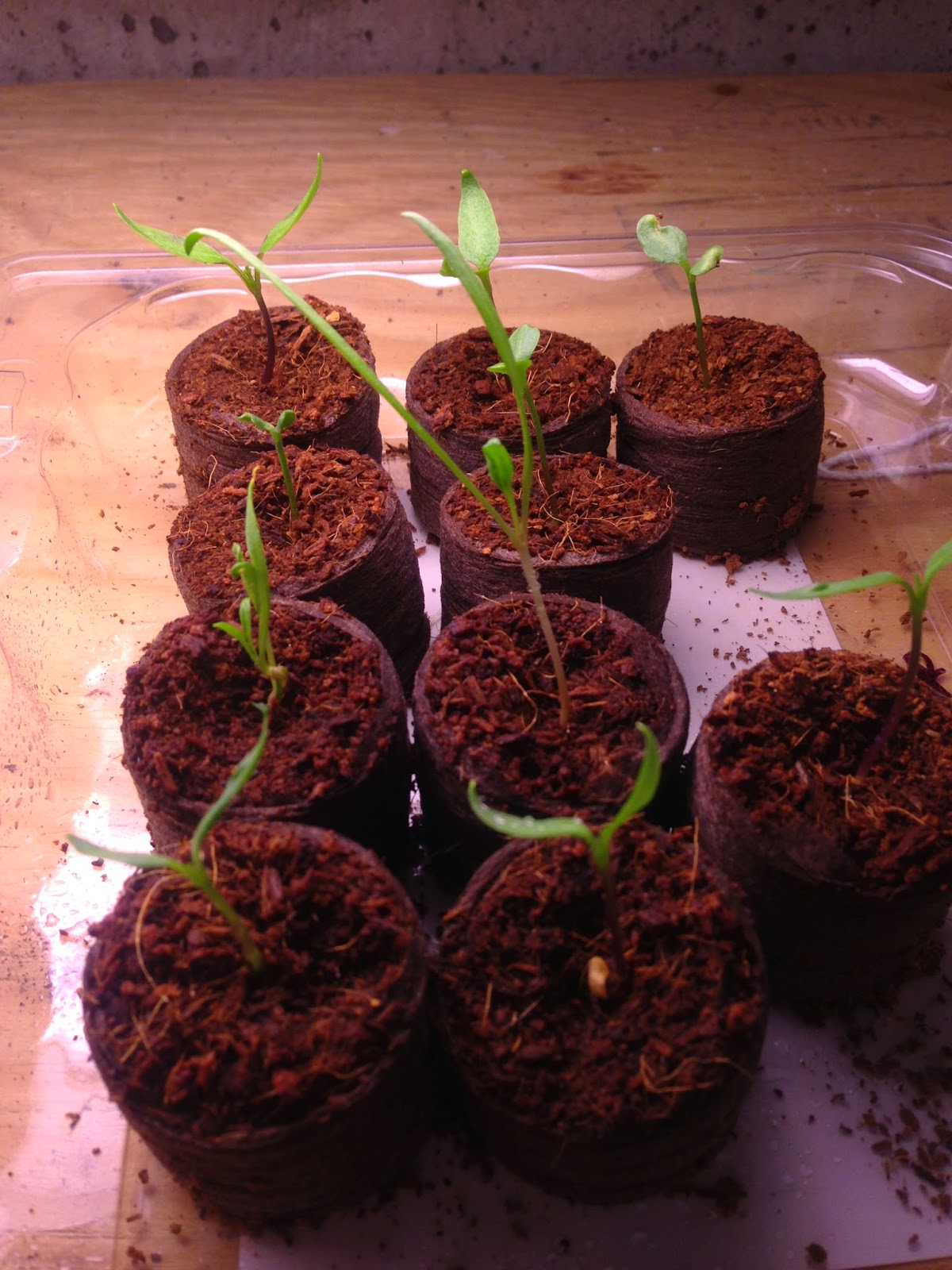
As for seeds, I'm still waiting on the cleome.  The seeds take anywhere from 14 to 21 days to germinate.  I'm on day 14.  The lavender is also taking a long time, and the spinach didn't do too well.  I only got 2 spinach seedlings from the seed I planted.  I accidentally mixed the spinach seedlings with the pepper seedlings and couldn't figure out why one "pepper" plant had such long rabbit ears! (picture 6)

Time is flying!  I still need to get out and prune my apple trees and other fruit trees, as well as two blueberry bushes.  All the other blueberry bushes are still too young/small.  I also need to get my asparagus crowns in the ground.

Sunday, May 26, 2013

Memorial Day Weekend - Journal Entry

These past 2 or 3 days have been cold and rainy.  Just a few minutes ago, I stepped outside to see how my plants are all doing.  What I saw was a little discouraging.

First, I went over to see my basil plants.  I noticed one of the seedlings had been eaten a couple of days ago, and then last night I discovered another plant was missing.   I suspect rabbits.  So, last night I put some clear plastic covers over the plants.  I have 4 basil plants left.  Yikes!  I plan on growing more seed, but I'm going to have to put some sort of protective cage around them.

Next, I walked over to my vegetable garden, half planted.  I had gone out last night to check the temperature of the soil and plants, because it was a very cold evening - 39 degrees.  As I was checking the temperature, I noticed that one of my eggplant seedlings had been ripped out of the ground and was just laying there.  When I went to replant it, I discovered the deep hoof impression that can only belong to a deer.  I hate deer.


So. I ran to the garage to grab a bottle of coyote urine that I bought to deter these pests.  One of my former instructors from WMMGA insists that it works, so I'm giving it a shot.  I soaked the cotton balls in the 3 vials that were provided with the urine and set them outside - one by the basil and 2 by the vegetable garden.  Because that didn't seem like enough, I dribbled more urine around the perimeter of the garden.

Today, as I inspected the garden, I can see that the plants are having a rough time.  The tomato plants actually look pretty good, but everything else looks a little battered.  Between the deer, rabbits, insects, cold, wind and rain, these little plants are having a rough beginning.

I'm just going to have to build a fence.  Eight feet high!!  It's not going to look great, but I don't care.  I'm tired of fighting these deer.  And coyote urine doesn't cut it.  After I came back in the house, I discovered that Shadow smelled disgusting!!! Apparently, he likes smell of coyote urine, and he managed to get it all over his fur.  Jamie had to sleep with him in the family room so that he wouldn't smell up the rest of the house, and then this morning gave him a bath.

On the positive side, the perennial garden looks beautiful!  There are a dozen plus alliums in bloom, and they look lovely with the small, yellow irises.  The taller, showier purple/yellow irises are also in bloom, and the purple midnight salvia looks magnificent.  Also in bloom are the pink geraniums, and the peonies, and white Japanese iris are about to bloom.  My new purple baptisia plant is also in bloom.

Photo courtesy of Treefarmsystem.org


Friday, May 24, 2013

Garden Notes - May 17, 2013


Setting Up the Vegetable Garden

This has been an extremely busy time.  For more than a week, I have been gradually exposing the seedlings to higher and lower temperatures, as well as more and more hours of sun.  It's made for a lot of running around, since many afternoons have been both rainy and sunny.  I have been watching the weather reports to make sure that the plants never sat outside below 50 degrees.  They have been getting maximum sunlight, too, so I have had to make sure the plants didn't dry out.  All and all, they have gotten used to being outdoors.

The weather report said the cold nights were over - meaning not really going below 50 degrees, so I decided to start putting the plants n the ground.  I had fertilized the soil weeks ago, so all I have to do is dig the holes, add a little fertilizer for each plant (3 T).  It's an organic fertilizer for tomatoes and vegetables.


So far, I have planted 9 Bellstar Tomatoes, 7 Yellow Pear Tomatoes, 8 cabbage, 8 eggplant, 8 bell pepper, 8 watermelon and 7 cantaloupe plants.
 
 
For the tomato plants, I cut off the lowest branches, as they seem to suck up a lot of the plants energy/food, but won't bear fruit.  At least I don't think those branches will.  I read on a gardening website that it's good to do this, as well as plant a bit of the tomato plant's stem in the ground - I think this is so it will grow more roots and strengthen the plant.


So, now some of my concerns:
  1. Only after I put the plants in the ground did I discover that the next 2-3 days are going to be cold.  One of the nights will actually dip down to 38 degrees!! I think I may try to cover the seedlings at night to protect them.  I'm not sure how yet, but I'm going to have to act fast.
  2. I did not rake/level the garden as thoroughly as I should have, so it is pretty uneven in parts.  I'm not sure how this will effect the plants, but in the fall I'm going to rototill everything! I would have/should have done it this spring, but as always, I just can't seem to get to everything.
  3. I'm worried about pesky critters eating my plants.  I still haven't figured out how I'm going to enclose this huge garden....
  4. I did not even think to leave paths between the rows of vegetables, so it's going to be a little challenging moving about the garden.  I have only planted half of the garden, so I will be sure to leave myself more room when I plant the rest.
  5. I did not put any stakes in for the tomato plants and am considering doing it this weekend so I don't disturb the roots later.

Monday, May 6, 2013

Hardening Off

After it was suggested that my plants have "fungus mites", I was told to start bringing my seedlings out into the light and air.  So, I decided to start hardening them off.
 
 
I know the goal of hardening off is to get the young plants gradually used to hotter and colder temperatures.  The other night, I left the plants out until it reached 50F.  The tomato plants looked like they were cringing:

They did recover, and I've been putting them outside and keeping them there until the temperature hit 48F.  When I brought the seedlings in, the eggplant seedlings, cantaloupe seedlings and cucumber seedlings didn't look so hot.  They looked very pale, and like they were losing their green color.

I went on line to see if I could find out more about hardening off.  I learned that certain plants should not be kept outside in temperatures below 60F, because they are tender.  I also read that the hardening off process should begin a week or 2 before planting day.

I have decided to bring the plants in when it gets down to 60F, and take a couple of weeks to fertilize the plants a bit.  I am starting with Super Thrive.

Recommendations Taken From Washington State University
  1. Harden off gradually, so that seedlings become accustomed to strong sunlight, cool nights and less-frequent watering over a 7-10 day period.
  2. On a mild day, start with 2-3 hours of sun in a sheltered location.
  3. Protect seedlings from strong sun, wind, hard rain and cool temperatures.
  4. Use an automatically opening cold frame, if you have one.
  5. Increase exposure to sunlight a few additional hours at a time and gradually reduce frequency of watering, but do not allow seedlings to wilt. Avoid fertilizing.
  6. Keep an eye on the weather and listen to the low temperature prediction. If temperatures below the crop's minimum are forecast, bring the plants indoors or close the cold frame and cover it with a blanket or other insulation.
  7. Know the relative hardiness of various crops. Onions and brassicas are hardy and can take temperatures in the 40's. After they are well hardened off, light frosts won't hurt them. Warm-season crops such as eggplants, melons and cukes prefer warm nights, at least 60° F. They can't stand below-freezing temperatures, even after hardening off. (See chart below for more detail.)
  8. Gradually increase exposure to cold.
  9. Root-prune plants in flats a week before setting out. Use a sharp knife and cut down to the bottom of the flat between the plants. Water thoroughly.
  10. After transplanting to the garden, use a weak fertilizer solution to get transplants growing again and to help avoid transplant shock.

Recommended Minimum Temperatures
Hardy40° F.Broccoli, Brussels sprouts, kohlrabi, cabbage, onions, leeks, parsley
Half-Hardy45° F.Celery, Chinese cabbage, lettuce, endive
Tender50° F.Squash, pumpkin, sweet corn
60° F.Cucumber, muskmelon
65° F.Basil, tomatoes, peppers
 
This chart has been taken from Washington State University